
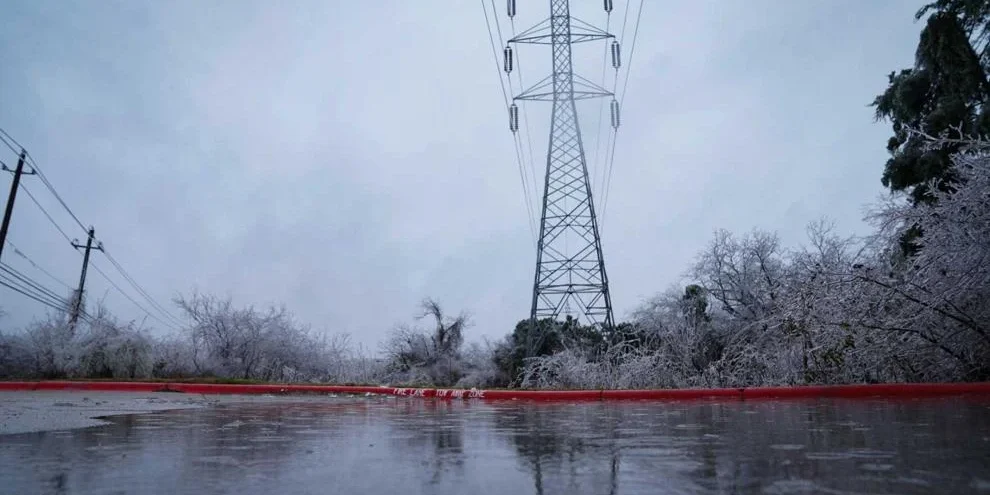
In contrast to the cascading events that crashed Texas’ power grid in the winter of 2021, the state’s energy generation and transmission have held up against increased demand under Winter Storm Fern.
Arctic air swept into West Texas on Friday and progressed across the state over the weekend, bringing sleet, snow, and ice that led to some local power outages. But the Electric Reliability Council of Texas (ERCOT), which manages the power grid for 90 percent of the state, has not issued any conservation requests and there has been no shortage in capacity.
“The time that was anticipated to be the tightest time for the grid was at 8:00 this morning,” Gov. Greg Abbott said during a radio interview with Mark Davis on Monday. “We have passed that, and the grid has held once again, works absolutely flawlessly, and that’s because of everything we’ve done over the past five years to make sure that the grid is stronger than it’s ever been.”
ERCOT, along with operators in New England and the Mid-Atlantic Region, were granted emergency waivers from the U.S. Department of Energy (DOE) to allow power generators to sidestep some environmental regulations and to require large energy consumers such as data centers to use backup generators for their operations.
“Under President Trump’s leadership, this administration is determined to take swift and decisive action to protect the American people from tragedies, such as Winter Storm Uri, which resulted in billions of dollars in damages and over 200 deaths,” wrote U.S. Energy Secretary Chris Wright in amended orders issued Sunday night.
Throughout the weekend, however, ERCOT reported excess capacity and at the projected peak at 8 a.m. Monday, the agency reported 90,989 megawatts (MW) of committed capacity compared to the demand of 75,713 MW.
Since Winter Storm Uri devastated the state in 2021, the ERCOT grid has undergone substantial reforms. In 2021, immediately following that February’s winter storm and blackouts, the Legislature passed robust physical weatherization reforms. In 2023, the body focused on reforms to the ERCOT market, including incentives to jumpstart the growth of the state’s long-stagnant thermal power fleet.
Last year, Abbott signed additional legislation that requires data centers and other large-load customers to contribute to infrastructure costs and empowers ERCOT to manage or curtail power usage during grid emergencies.
Will McAdams, a former commissioner of the Texas Public Utility Commission (PUC), told The Texan that the grid performance during this week’s storm was “a very successful event in terms of low forced outage rates among our generators.”
McAdams explained that a primary concern going into this week’s storm was that wind turbines in West Texas might be frozen and remain offline until they could be thawed, but they remained operational.
He also noted that prices remained lower than predicted and said the number one factor in grid stability this year came from “15 gigawatts worth of batteries.”
“You have a lot of battery capability spread out over the state and they’re all hoovering up cheap energy whenever they can store it and then trying to sell that into the system at high price. And the net effect of that is, that as they all are chasing the higher price, they’re keeping prices lower than they otherwise would have been,” said McAdams.
“That’s really the story of the grid of today versus the grid of five years ago,” he added.
Appointed to the PUC in 2021, McAdams said that while he wanted to keep electricity affordable, his main goal was to “keep people safe” by ensuring that any power outages were minimal and restored quickly.
While solar generation contributed significantly to the power supply during daylight hours according to ERCOT, use of natural gas-generated power carried Texans through high demand hours in the early morning and evening over the weekend.
El Paso, some of the Panhandle region, and areas of Northeast and Southeast Texas are not managed by ERCOT but operate under other grid networks.
Early on Monday, CenterPoint reported about 1,400 customers without power in the Greater Houston area, but by the afternoon the number had dropped to fewer than 1,000.
The Southwestern Electric Power Company reported ongoing outages due to local events in the Longview region of Texas as well as portions of Arkansas and Louisiana.
One man found near a gas station in Austin reportedly died of hypothermia and a teen was killed in a sledding accident in Denton County, but no deaths had been reported due to power outages in Texas as of Monday .
“In Tarrant County, there’s almost a million customers. There’s only 113 that are out. In Dallas County, there’s more than a million customers. Only 227 are out. And so, the grid is holding up absolutely fine, withstood a very tough test and made sure that the power stayed on in ultra-cold temperatures for multiple days,” said Abbott.
Published originally at The Texan. Click here to read the original article.